
EFFECTIVE GLASS REUSE THROUGH REGIONAL FACILITIES
By Finley Collins | Circularity Research Analyst, SPR
In Parts One and Two of our “All About Glass” series, we examined the factors that determine which downstream routes recovered solar glass can take and the complexities that necessitate a myriad of supply chain partners. In this final section, we will discuss the reuse strategy that results from the intersection of these realities: the regional facility model.
REUSE AT SCALE
We already know that glass is the dominant component in solar panels, constituting around 60-70% of the total mass for single-sided panels and up to 80% for the increasingly popular bifacial panels. Most of the reuse logistics therefore concern moving large quantities of heavy, low-value material – a process that cannot be sustainable, fiscally or environmentally, if it is not made as efficient as possible.
Take for example, a million+ panel repower; the scale of some projects that SPR is undertaking. Extrapolating the panel’s composition across a project of this size, you’re easily looking at 30-40 million pounds of glass that will need to re-enter the market. Against the DOTs maximum gross vehicle weight (GVW) of 80,000 pounds, a single utility-scale project can generate up to almost 900 truckloads of glass alone.
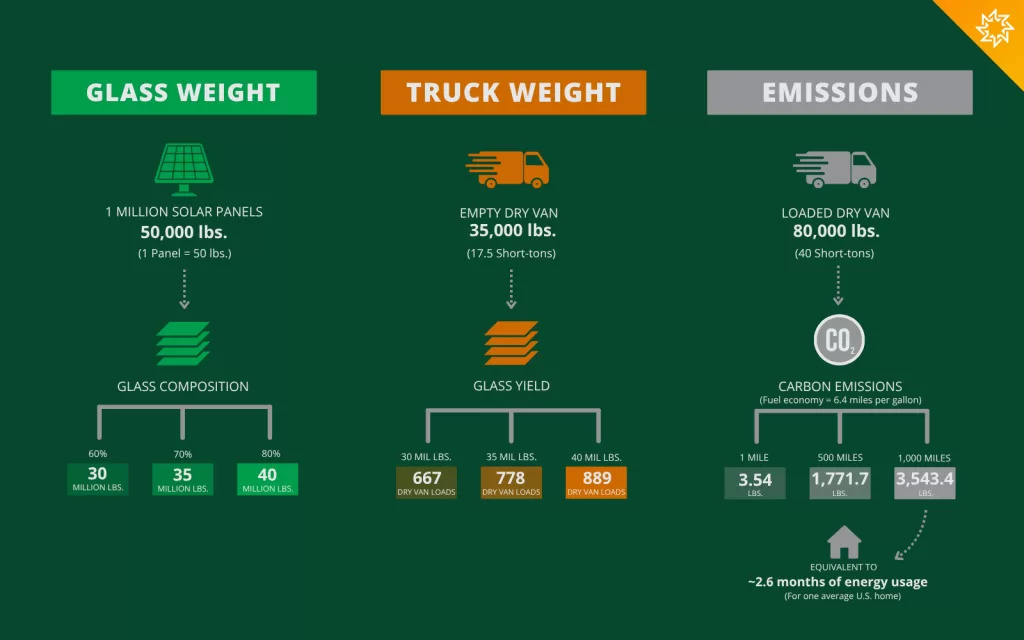
At a minimum, each truck carrying a full load of glass would generate almost 16.5 pounds of CO2 for every mile it travels. One truckload of glass traveling 1,000 miles creates 3,543 pounds of CO2—the equivalent of 2.6 months of energy usage for one average U.S. home. At scale, cross-country transport quickly loses viability, both for maintaining costs and reducing emissions.
REGIONAL FACILITIES: THE BENCHMARK FOR SOLAR RECYCLERS
Without regional infrastructure, the benefits from material recovery and reuse can quickly be eroded by long transport distances. Shortening the route between recycling facilities and the point of reuse becomes increasingly prudent when recycling at scale, and even more so as EOL and repower volumes continue to grow.
This is where supply chain design meets decarbonization strategy. The more localized the material loop, the lower the net carbon intensity of the recycled output — and the more it strengthens the solar industry’s climate mission.
Sources:
- Sustainability In Your Ear: Building Solar Panel Recycling Capacity with SPR’s Brett Henderson, Earth911®
- Comprehensive Truck Size and Weight Limits Study – Volume 1: Technical Reports Summary, U.S. Department of Transportation – Federal Highway Administration